Every potter remembers the session where centering finally clicked. Almost nobody remembers it as the session where they got stronger. What changed was that they stopped pushing the clay and started holding still while the wheel did the work.
Wedge properly first
Air pockets and uneven moisture make clay that cannot be centred by anyone. Wedge for a full two minutes — ram’s head or spiral, it does not matter which, as long as the clay comes off the bench uniform.
Throw the ball down hard
Aim for the centre of a slightly damp bat and commit. A ball that lands off-centre can still be recovered, but you are starting the fight one round down.
Fast. Faster than feels comfortable. Centering happens at high speed, shaping happens at low speed, and beginners almost always run the wheel too slow.
Brace, do not push
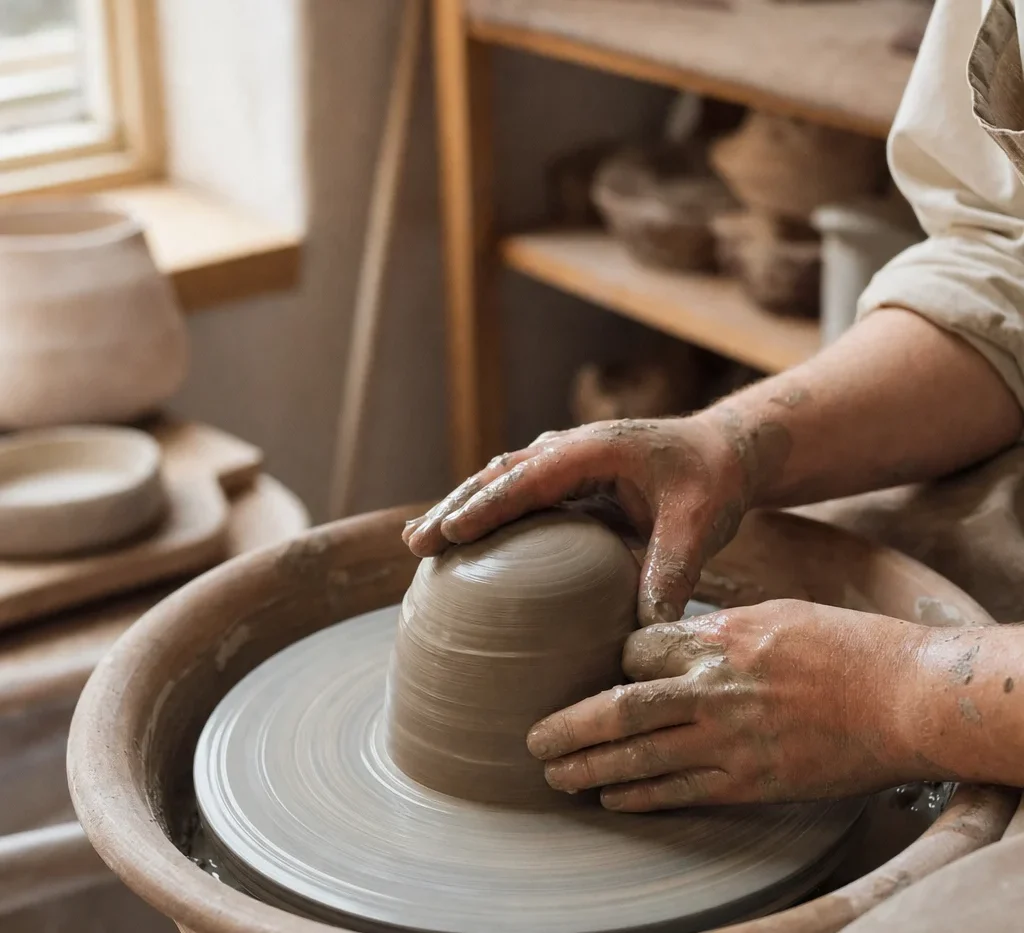
Elbows locked into your hips. Forearms resting on the wheel rim. Your hands should be an extension of the wheel frame, not two independent things waving at the clay. The clay comes to your hands because they will not move.
- Left hand on the side, pushing inward toward centre.
- Right hand on top, pushing down and slightly inward.
- Both hands steady for at least ten full rotations before you judge anything.
Cone up, cone down
Squeeze the clay upward into a tall cone, then press it back down into a mound. This is how you finish aligning the clay particles, and it is the step that separates clay that is nearly centred from clay that is genuinely centred.
Two or three cycles is normal. Six means your clay was not wedged.
Test with a closed eye
Rest a knuckle lightly against the spinning clay and close your eyes. If you feel a bump once per rotation, you are not centred. If you feel nothing, you are. Your hands will always know before your eyes do.
If the clay is still fighting after four cone cycles, take it off. Something is wrong inside it, and no amount of pressure will fix a trapped air pocket.