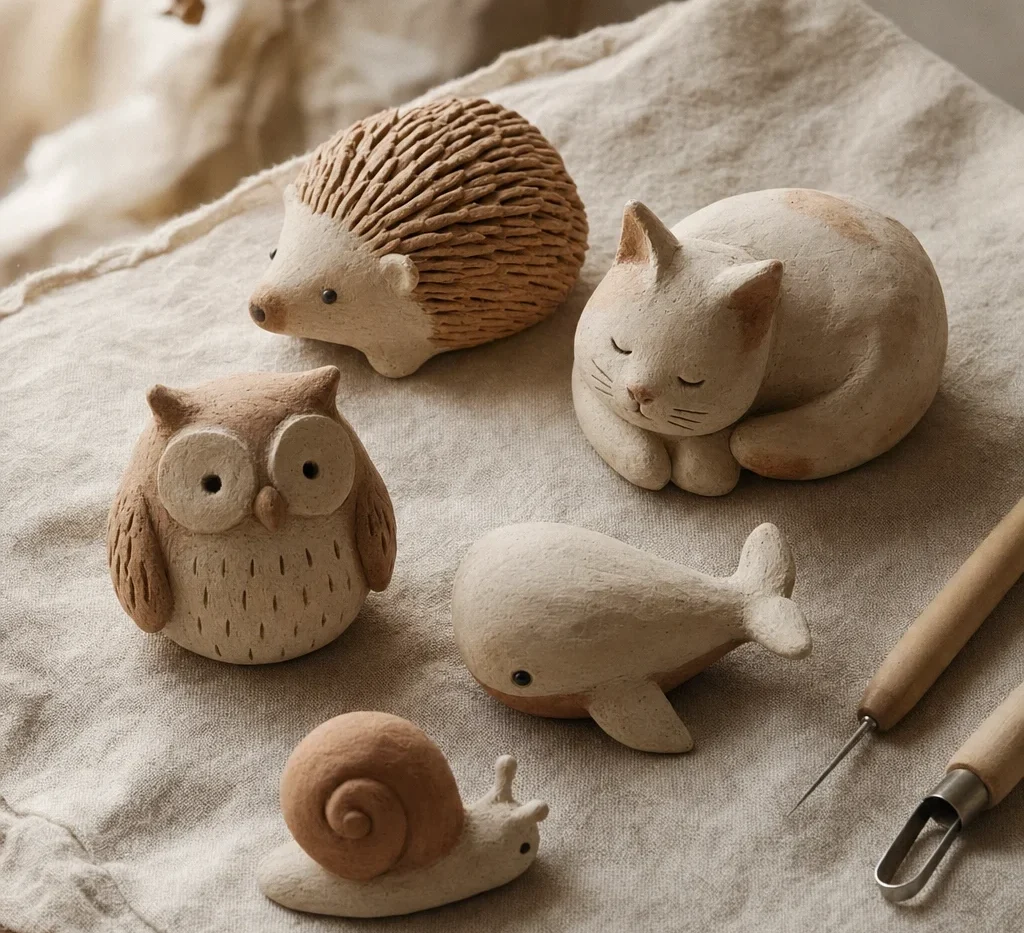
Beginner sculpture advice usually starts with anatomy, which is exactly backwards. Start instead with subjects that are mostly one round shape, because a round shape is the thing every beginner can already make.
Pick a forgiving animal
Hedgehogs, owls, whales, cats curled asleep, capybaras, snails. All of these are essentially one mass with small additions. Nobody can tell if a sleeping cat is anatomically off by five percent.
Build the mass first
Get the body right before you add a single feature. Most beginner sculptures fail because the ears went on while the head was still the wrong shape, and then everything after that is compensating.
Step back two metres and half-close your eyes. If the silhouette does not read as the animal, no amount of detail will save it. Fix the silhouette.
Attach properly or it will fall off
Score both surfaces with a needle tool, add a little slip or water, press and blend. Ears and tails that are simply pressed on will separate as the piece dries. Every time.
Add texture last, and less than you think
A fork drawn across a hedgehog. Three curved lines for a wing. One shallow dent for a closed eye. Restraint here is what separates a sculpture from a craft-fair table.
- Texture the large areas, leave the face smooth.
- Eyes as dents, not as added balls — added eyes look startled.
- Stop about two moves before you think you are finished.
Hollow anything thicker than 2cm
Solid clay thicker than about two centimetres cracks as it dries, and explodes if it is ever fired. Cut the piece in half, scoop it out, and rejoin with scoring and slip.