There is a moment, usually about three weeks in, when a new potter stops apologising. The bowl is still lopsided. The glaze still pooled where it should not have. But something has shifted, and the piece is no longer a failed attempt at a symmetrical bowl. It is just a bowl, with a history you can read in the surface.
That shift has a name. It is roughly what the Japanese aesthetic tradition calls wabi-sabi, and it has been quietly organising how people look at ceramics for about five hundred years.
What the words actually mean
Wabi began as a word about loneliness — the particular austerity of living simply, away from things. Sabi was about the beauty that arrives with age: patina, wear, the softening of a hard edge by decades of hands. Together they describe a preference for the weathered over the pristine, and for the specific over the perfect.
The tea masters of the sixteenth century took this seriously enough to reject flawless imported Chinese porcelain in favour of rough local bowls, made fast, fired unevenly, and often visibly repaired.
Nothing lasts, nothing is finished, and nothing is perfect.
Why it matters at a kitchen table
Because most people who start working with clay are carrying a picture in their head of what the finished thing should look like, and that picture is usually a photograph of something made by a machine.
Held against that standard, everything handmade fails. The walls are uneven. The rim wavers. There is a thumbprint near the base that you did not intend to leave and cannot now remove.
Wabi-sabi does not ask you to lower the standard. It asks you to notice that you were measuring against the wrong thing. The thumbprint is not damage. It is the only proof that a person was here.
Kintsugi and the honest repair
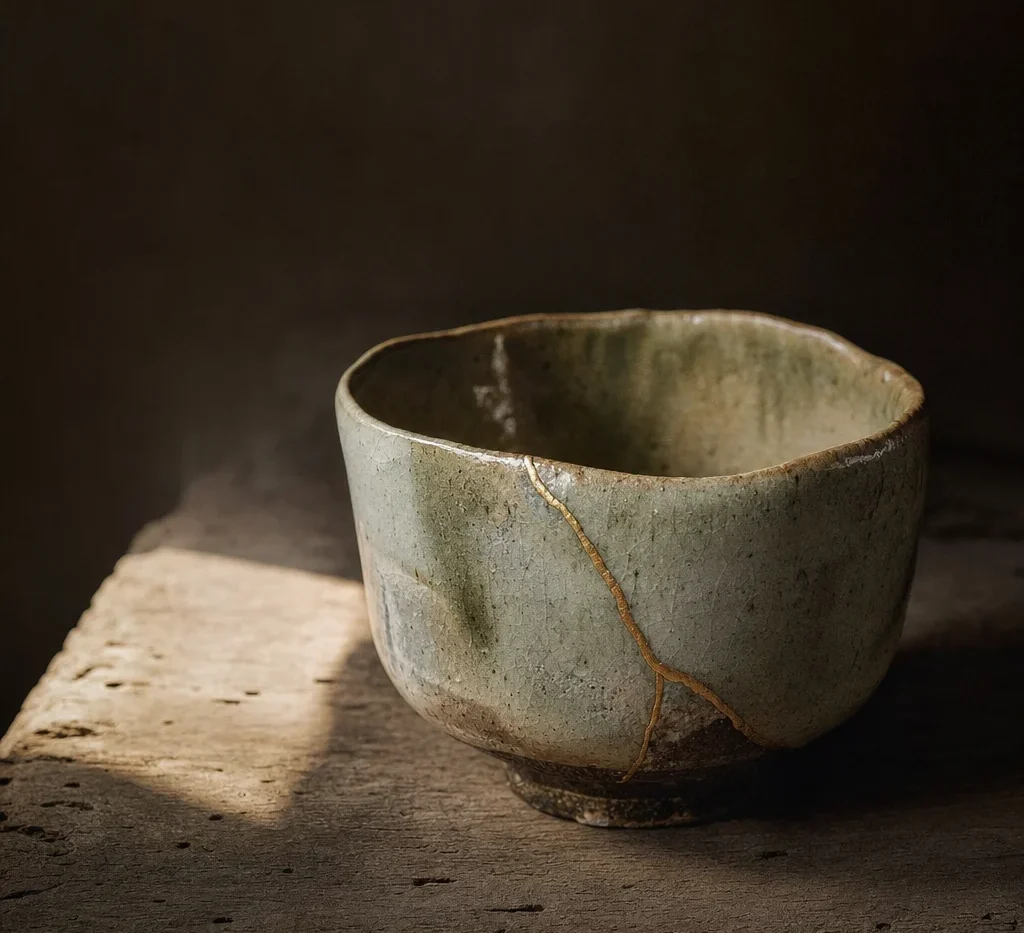
The clearest expression of this is kintsugi — repairing broken pottery with lacquer mixed with gold, so the mend is the most visible part of the object. Not disguised. Emphasised.
A kintsugi bowl is worth more than it was before it broke. The break is part of what it is now, and pretending otherwise would make it a lesser object, not a greater one.
How to actually make this way
It is not a licence to be careless. The tea bowls were made quickly but not carelessly, by people with enormous skill, choosing to leave the marks of the making visible.
In practice that means: throw the pot and stop. Do not sand away every trace of the hand. Let the glaze break over the texture instead of levelling it. Keep the piece where the clay did something you did not plan, and look at it for a week before deciding it was a mistake.
The first bowl you made is not a bad version of a good bowl. It is the only record of the first time your hands did that. Keep it on the shelf where you can see it.