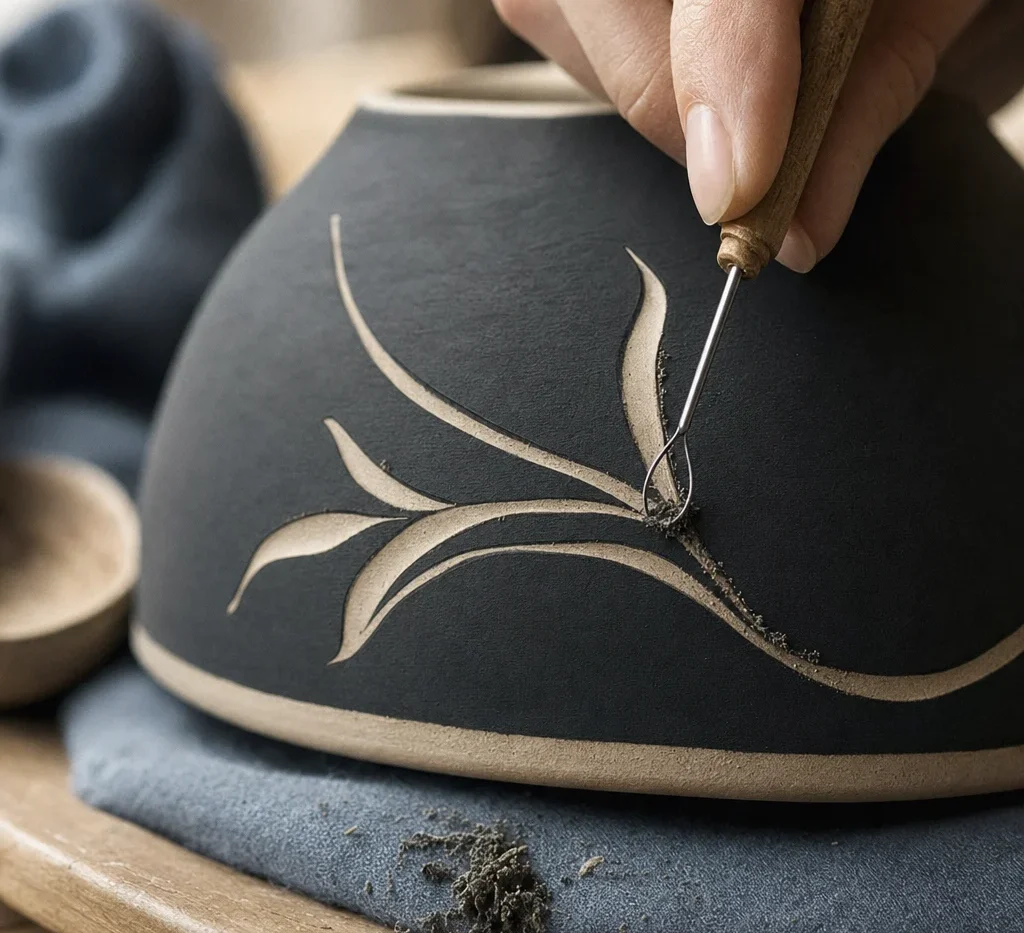
Sgraffito is Italian for scratched, and that is the entire technique. The reason it looks so good is contrast: a dark slip over a pale body gives you a line with a crisp edge and a slightly raised burr, which catches light in a way a painted line never does.
The clay must be leather-hard — firm enough to hold a line, soft enough to carve without chipping. Too wet and the line smears. Too dry and the slip flakes off in sheets.
Bring the piece to leather-hard
It should feel cool and firm, like a hard cheese. You can press a fingernail in and leave a mark without deforming the wall. That is the window, and it lasts a few hours.
Apply the slip evenly
Two or three thin coats with a soft wide brush, each in a different direction, letting the surface lose its shine between coats. Thin coats carve cleanly. One thick coat cracks as it dries.
Let it set, then draw
Wait until the slip has gone matte but the piece underneath is still leather-hard. Sketch lightly with a needle tool first — these guide lines vanish under the carving.
Carve through to the body
Hold the loop tool at a shallow angle and pull toward yourself in one confident stroke. Hesitant strokes wobble. If you need a long line, turn the piece rather than changing your grip.
- Carve away from your supporting hand.
- Work from the top of the piece down so the dust falls onto uncarved areas.
- Dust with a dry brush constantly — you cannot see your line under a layer of crumbs.
It has dried too far. Cover the piece loosely in plastic for an hour to let the moisture even out, then try again.
Clean up and dry slowly
Soften any burr with a dry finger once the piece is bone dry. Then dry it slowly under loose plastic — a carved piece has thin and thick areas and will crack if one dries faster than the other.